Judge the tool by observable evidence
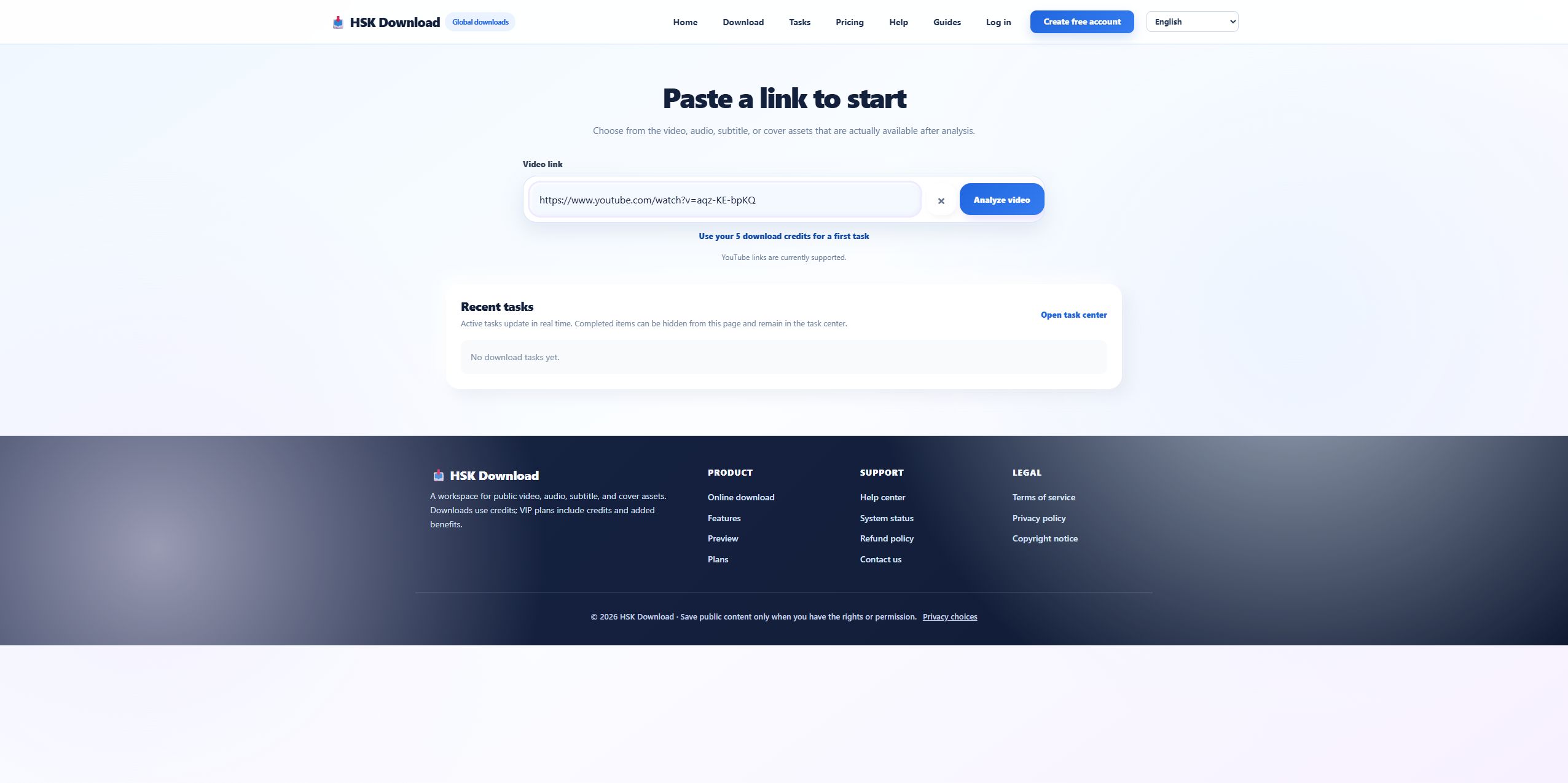
Searching for a youtube downloader often produces pages that look interchangeable. Do not rank them by the size of the Download button. Use a permitted control source and score what the tool proves. On 2026-07-29, our control was Blender’s official “Big Buck Bunny 60fps 4K - Official Blender Foundation Short Film.” The HSK Download result matched the title and thumbnail, exposed source-dependent choices, displayed estimated sizes, and showed the account boundary before task creation.
Signal one: source identity is explicit
A responsible tool should let you confirm that the returned item is the intended video. The control result named the Blender film and showed its recognizable thumbnail and 2160p label. A tool that jumps directly from pasted URL to an unlabeled file removes an important safety check. If title or artwork is wrong, do not continue merely because the page offers a familiar extension.
Signal two: unavailable choices are not fabricated
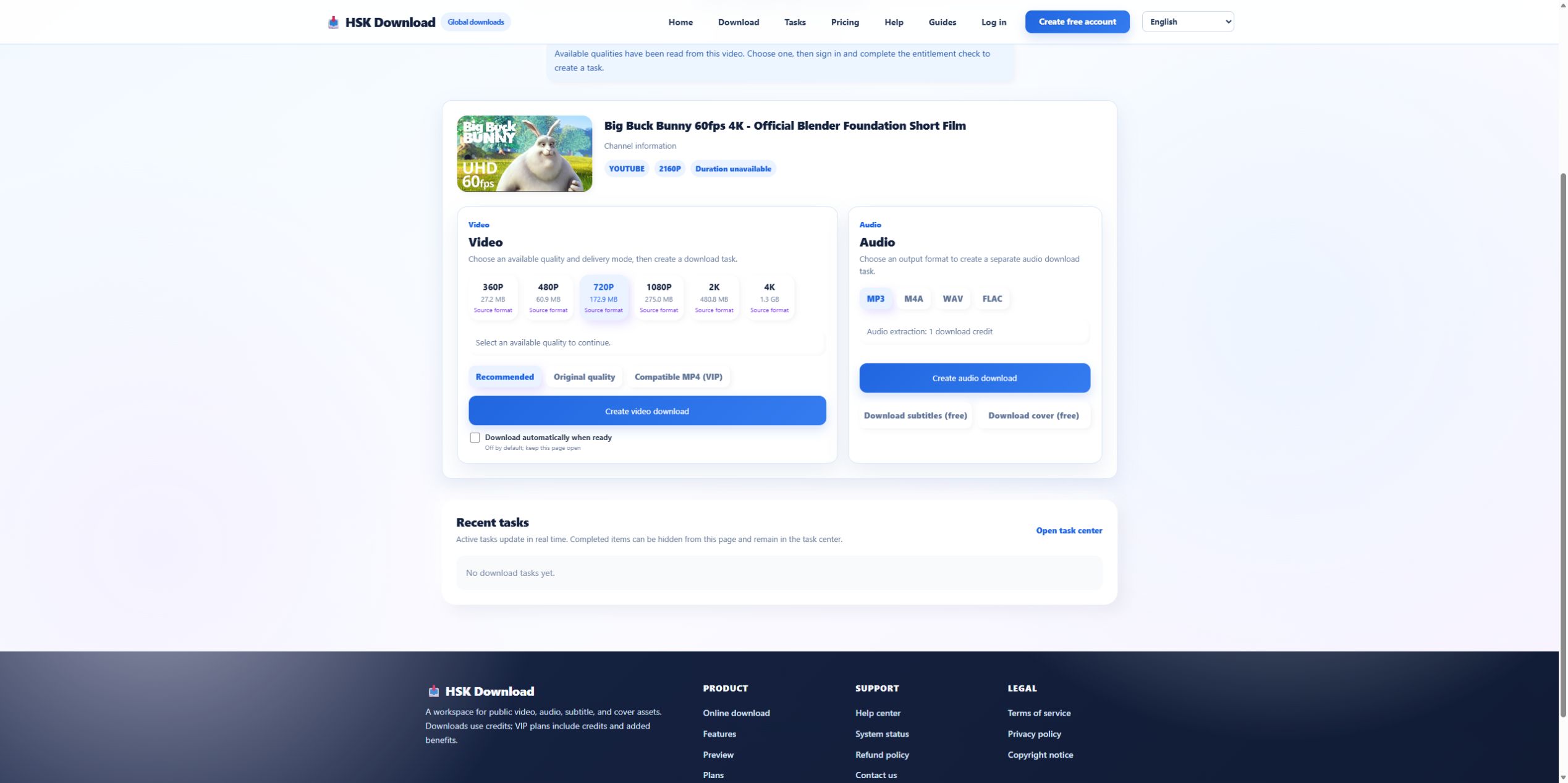
The control exposed exactly six video options—360P, 480P, 720P, 1080P, 2K, 4K—and four audio formats. That is better evidence than a static menu that advertises 8K, 320 kbps, or every possible format before examining the source. A trustworthy result changes with the source. It does not imply that a keyword can create assets that the publisher never supplied.
Signal three: storage cost is visible before commitment
For this source, the displayed estimates ranged from 27.2 MB at 360P to 1.3 GB at 4K. Showing size early helps a user avoid a failed mobile download or unnecessary transfer. Treat an estimate as planning data, not a guaranteed final byte count. The actual output still needs verification after an authorized task completes.
Signal four: delivery modes have clear meanings
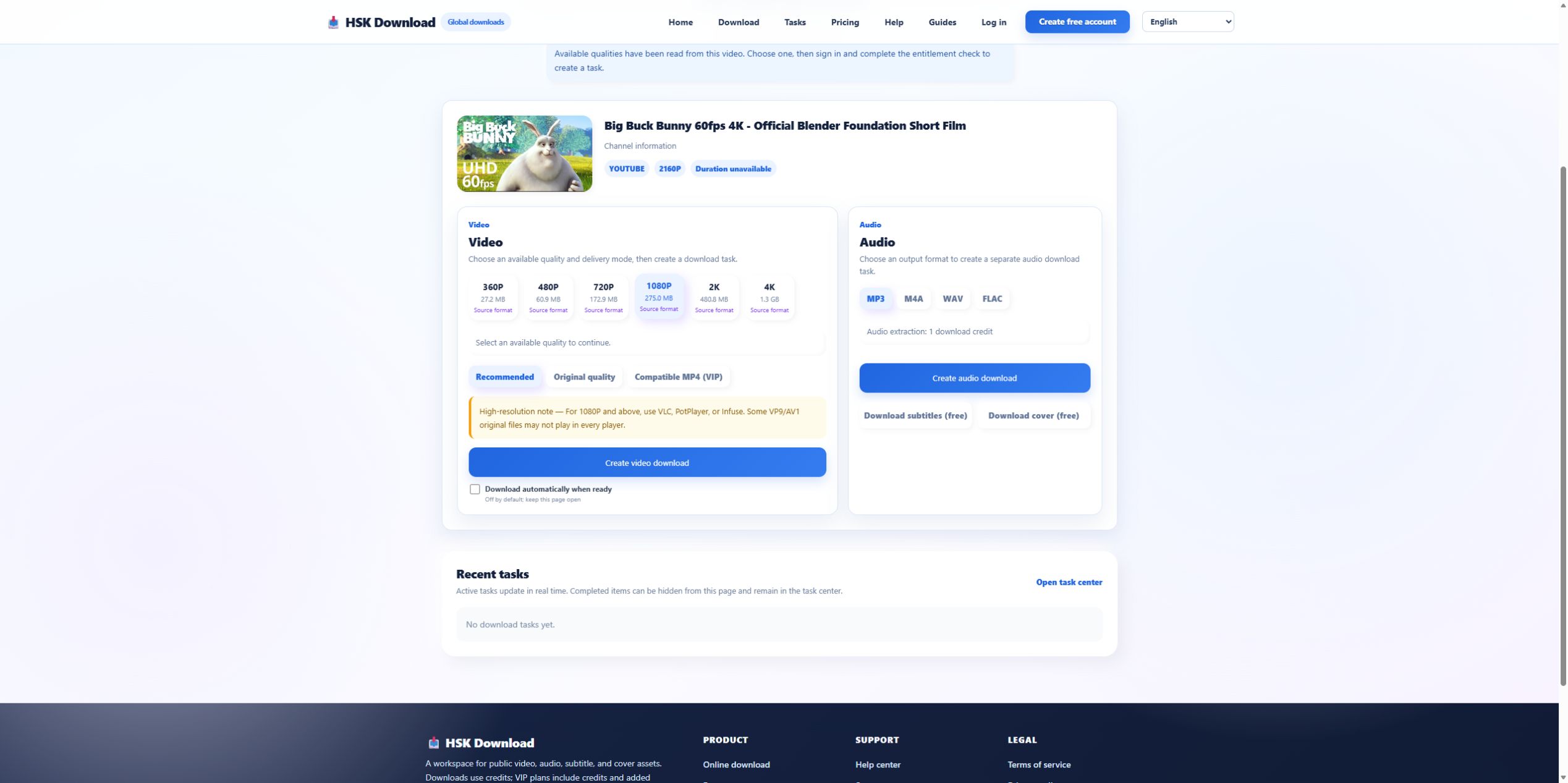
The video panel separated Recommended, Original quality, and Compatible MP4 (VIP). That distinction tells the user that source fidelity and device compatibility may require different paths. A downloader that labels every output “original” without showing the codec, source representation, or compatibility trade-off provides less actionable information. Record both the resolution and delivery mode when comparing results.
Signals five and six: account and task boundaries are visible
The control page did not disguise the next step: it required sign-in and an entitlement check before task creation. That is a clearer boundary than silently consuming a credit or presenting an advertising redirect as the file. After a task is accepted, a credible product should expose queued, processing, completed, or failed state. Until a task exists, no guide should claim conversion success.
Signal seven: privacy and rights are part of the workflow
Look for a clear privacy policy, copyright notice, and a way to contact support. Avoid entering private or access-controlled URLs into an untrusted page. Do not paste session tokens, cookies, or cloud-share credentials. A public video still requires ownership, a license, or permission for the intended use. The control source was chosen because Blender publishes an official project record; that evidence is more useful than assuming that popularity equals permission.
Use a compact scorecard and keep the result
Give one point for each signal: correct identity, source-dependent options, visible size, explained delivery mode, explicit account boundary, observable task state, and accessible privacy/rights information. A score is not a legal guarantee, but it forces a comparison based on user-visible behavior. Run the same authorized source, browser, and date for each tool. Start the HSK check on the English download page and preserve screenshots without personal data.
Evidence ledger for “YouTube Downloader Evaluation: A Seven-Signal Test Before You Trust a Tool”
Evidence date: 2026-07-29. Control source: Big Buck Bunny 60fps 4K - Official Blender Foundation Short Film from the official Blender channel (10:34 in the YouTube player). The live analysis exposed 6 video resolutions, 4 audio formats, subtitles and cover, then required sign-in and an entitlement check before task creation. This ledger states exactly which observations support undefined and prevents the article from implying that a completed file was produced when the run stopped at the documented account boundary.