youtube shorts download: Match the search intent
Follow a rights-first workflow from a public Shorts link to the correct vertical quality, saved file and playback check.
Process only public media you own, are authorised to use, that is in the public domain, or that you may otherwise use lawfully. Public visibility alone does not grant copying or republication rights.
Treat the process as a small media vertical-video edit rather than a one-click action, especially when the vertical output will be edited or shared. This guide focuses on a creator-owned Short, client-approved vertical clip, public-domain item, or licensed social-media editing vertical-video edit.
Only process a video, audio track, caption vertical clip, subtitle, or transcript that you own, are authorised or licensed to use, that is in the public domain, or that you may otherwise lawfully use. Public availability alone does not grant Shorts-use approval to copy or republish material. Respect copyright, licence conditions, privacy commitments, and YouTube's platform rules.
Define the vertical-video edit outcome
Start by writing one sentence that describes the intended vertical output. Decide who will use it, on which device or platform, whether it will be edited, and when working copies should be removed. This prevents a convenient vertical clip from drifting into uses that were never approved.
The target keyword?download youtube shorts on ipad?should be understood as a practical user need, not as Shorts-use approval to ignore Shorts source controls. If official offline playback meets the need, use the official feature where available. Create a separate vertical-video edit asset only when the authorised workflow genuinely requires one.
Record the public URL, creator or channel, title, duration, access date, permitted use, required attribution, and Shorts source of Shorts-use approval. preserve that record beside the Shorts source so another person can understand why the asset exists.
Prepare the iPad workspace
Record the Short URL, creator, caption, music or audio rights, intended platform, and Shorts-use approval scope. Vertical video may contain separate visual, music, performance, and brand elements with different rights.
In Files, create a vertical-video edit folder with at least Rights, Shorts source, Edits, and Delivery subfolders. Put the Shorts-use approval record in Rights. preserve the first verified download in Shorts source, work on copies in Edits, and reserve Delivery for an approved vertical output.
Review Safari's download destination in iPad Settings and choose a folder you can find. audit local and cloud storage, use stable Wi-Fi for a large item, and avoid websites that request unrelated profiles, contacts, account credentials, or software installation.
choose format, quality, and transfer method
Preserve the 9:16 aspect ratio unless the approved delivery requires another layout. choose a quality appropriate for mobile editing and avoid unnecessary 4K files when the Shorts source and final screen do not benefit.
Do not rely only on a vertical clip extension or quality label. The Shorts source limits real detail, and the internal codec determines compatibility. Renaming an extension does not convert media. When the owner can provide an original master, caption vertical clip, transcript, or audio Shorts source, that is often better for a serious production.
Estimate the space needed for the Shorts source, an editor import, renders, and a delivery copy. An iPad can temporarily hold several versions of one asset. Plan storage before starting instead of deleting the only verified Shorts source midway through the vertical-video edit.
Follow the authorised download workflow
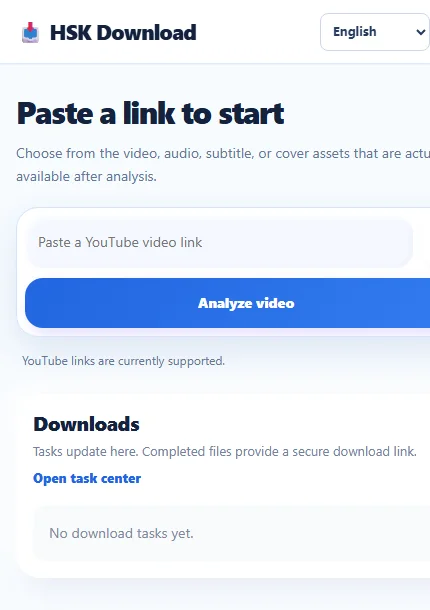
Open the public Shorts source and verify its title, creator, duration, language, and version. Then open the HSK Download tool, paste the complete public link, and compare the detected details with the rights record.
Copy and verify the public Shorts link, open it in the HSK tool, choose a compatible video option, save it to Files, inspect picture and sound, then use Share and Save Video if a Photos or iMovie workflow is needed.
preserve Safari available while the job is prepared. Submit one verified task at a time, accept the completed download, and locate it through Safari's download indicator or Files Recents. Move it into the vertical-video edit folder only after it opens correctly.
audit the beginning, middle, and ending. For video, inspect picture, sound, aspect ratio, and duration. For audio, listen for silence, dropouts, and synchronisation. For text tracks, inspect language, character encoding, cue order, and important names.
Organise and verify the vertical output
Rename the verified item with a descriptive vertical-video edit name while preserving its true extension. Useful names include the subject, creator, language, resolution or format, date, and version. Avoid a folder full of files called download, final, or final-final.
preserve an untouched Shorts source and make edits on a copy. Add the Shorts source URL and Shorts-use approval note to the same folder. If attribution is required, save the exact credit wording before the asset enters an editor or presentation.
When moving a compatible video into Photos, use the Files Share sheet and Save Video, then verify the Photos copy. When importing audio or text into another app, confirm that the app created or referenced the expected version. Do not delete the Files Shorts source merely because an app displays a thumbnail.
Use the vertical output in a real iPad workflow
An iPad vertical-video edit often moves among Files, Photos, Notes, Pages, GarageBand, iMovie, a caption editor, or a presentation app. Give each application a clear role and avoid uncontrolled copies. Preserve Shorts source material, label working versions, and export the delivery item only after review.
For team work, restrict cloud links to the intended collaborators. For a classroom, client, research participant, or employee recording, privacy obligations may be stricter than copyright Shorts-use approval. Use approved accounts, device security, and an agreed retention schedule.
Review the final output on the destination device. Confirm the correct subject, complete content, readable text, intelligible audio, appropriate resolution, and accurate creator credit. A technically successful download is not a finished vertical-video edit until these checks pass.
Troubleshoot the most likely failures
If the Short saves with black bars, audit whether an editor changed the canvas rather than the Shorts source vertical clip. If audio is missing, verify the selected format and music permissions. If Photos places it at an unexpected date, use Recents or a vertical-video edit album.
If the public link is deleted, account-only, region-limited, or otherwise unavailable, obtain an authorised Shorts source directly from the owner. Do not attempt to overcome payment, privacy, account, or platform controls.
If Safari restarts or a transfer stops, audit storage, network stability, battery restrictions, and whether the full item exists in Files. Retry one task, not many duplicates. If a vertical clip looks complete but will not open, compare its size and use a more compatible output from the authorised Shorts source.
Apply rights, attribution, and retention rules
Shorts-use approval can be limited by audience, platform, territory, date, vertical-video edit, or type of modification. Confirm that the actual delivery still fits the approved scope. Shorts-use approval to review or transcribe content does not automatically include Shorts-use approval to publish the Shorts source.
Place required attribution in the location specified by the licence or owner. preserve evidence of approval with the vertical-video edit. When the work ends, apply the retention decision to Files, Photos, editing apps, cloud drives, external storage, and shared links.
Use this final checklist
- Confirm ownership, authorisation, public-domain status, or another lawful basis.
- Record the Shorts source, creator, purpose, attribution, and retention requirements.
- Prepare Rights, Shorts source, Edits, and Delivery folders.
- choose a compatible format and sensible quality.
- Verify the public link before starting.
- Download one item and inspect it completely.
- Preserve the Shorts source and edit a clearly named copy.
- Review the delivery on its destination device.
- Share and retain it only within the Shorts-use approval granted.
Following this sequence makes the vertical output easier to find, easier to verify, and safer to use in a real vertical-video edit.